This blog was written by a human. As a content writer – and especially as a creative in the age of AI – I take a great deal of pride in that statement and in knowing that my writing is uniquely mine.
Still, I sometimes feel this unnerving sense of doubt creeping up on me; a discontent with both the efficiency and quality of what I create at work. Each day I end up facing a variation of the same uncomfortable questions: am I being held back by my own stubborn refusal to adopt AI tools? Am I no different than the Luddites who once decried the very technologies and industrial innovations that now shape our entire world?
Like it or not, AI is here to stay. And in 2026, the rapid and transformative impact it's having on our lives is showing no signs of slowing down. There are certainly some alluring benefits to using AI in the workplace, especially in technical fields where precision and automation are key. But in creative and artistic fields, could the introduction of AI technology bring about a new renaissance, or would its use only serve to diminish the innate connection between humankind and the things we create – and are we really prepared to pay the price either way?
This blog will take a magnifying glass to the polarizing topic of AI and examine how these tools can both help and hinder human productivity and expression, and what that ultimately might mean for humanity as we plunge deeper into the era of artificial intelligence.
The AI Boom is Here
When ChatGPT launched in November of 2022, the world changed forever. Overnight, the concept of artificial intelligence jumped from a sci-fi trope into a common household name. Now in 2026, AI is everywhere: from the chatbots and search engines we use to the videos and advertisements we consume, no industry has been left untouched by the explosive rise of accessible AI technology.
This tidal wave of artificial intelligence – and especially generative AI – has already seeped its way into many of those tedious, menial tasks we all secretly dread at work. It can help with problem solving, provide ideas and feedback on your work, and even summarize those headache-inducing email threads that got out of control 7 reply all’s ago.
The time saving potential from small shortcuts like these can add up fast, so it’s no wonder more and more companies are scrambling to implement the latest AI tools into their business models. Time saved is money made, after all, and it’s hard to argue with the results AI tools can deliver.
The generative capabilities of AI have evolved over the last few years as well, blurring the line between reality and fiction. AI-generated content has taken the world by storm; the newest models can create fully-realized text and media with shockingly high fidelity, including images, audio and video. It can even replicate human activity on social media by running entire profiles more-or-less autonomously.
Over the last few years, investments into AI-related technologies have multiplied exponentially, making up over half of all global financial investments in 2025. Many companies see AI as the future, and they’re diving head-first into the idea of a workforce driven and powered by artificial intelligence. Of course, this doesn’t come without a human cost, but we’ll get to that; for now, AI is clearly where the money is.
With new innovations and updated models popping up left and right, there’s no telling what artificial intelligence will be capable of 5, 10 or 20 years down the line. For now though, one thing is certain: until the bubble pops, this is our new normal, and refusing to get on board is a risk many businesses just aren’t willing to take.
The Real Cost of “Artificial Intelligence”
At a glance, the advantages of AI in the workforce seem almost too good to be true. It can automate busywork, generate content from scratch, and give people the ability to optimize their workflow like never before. So what’s the catch?
Unfortunately, the boom we’re experiencing isn’t quite so cut-and-cry. The benefits of AI are really just the tip of the whole iceberg – and once you go a bit deeper, it doesn’t take long for the cracks to start showing.
While AI can pull off some impressive tricks, the computational power required to make the magic happen doesn’t grow on trees. AI data centers – essentially the heart and brains of the entire operation – consume a staggering amount of resources on a daily basis, and more of them are propping up all over the world. Right here at home, a planned $10 billion data centre in Alberta is projected to consume a similar amount of electricity as the entire city of Edmonton – a city of over 1.2 million people – all by itself.
While power grids buckle under this strain, a few tech giants like Google, Amazon and Microsoft have even floated the idea of acquiring their own personal nuclear reactors just to fuel their AI. That’s a lot of power.
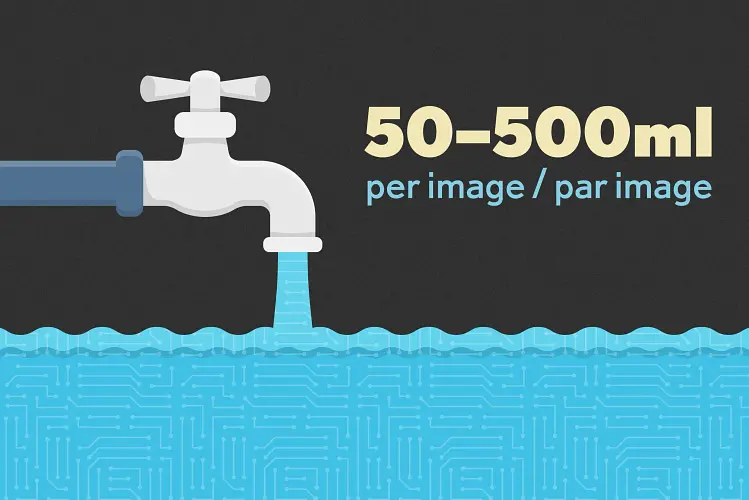
It’s not just electricity being consumed, either. These data centers each house thousands of GPUs running 24/7 at full capacity, and that generates some serious heat. In such a confined space, the only way to keep things reasonably cool is with water cooling on a massive scale. Generating a single image with AI is estimated to use anywhere from 50ml to 500ml of water.
For context: at the height of the AI Ghibli trend last year, an estimated 700 million images were generated in the span of 72 hours. At the lowest estimate, that’s around 35 million gallons of water, or 14,000 Olympic-sized swimming pools, consumed in just 3 days. The trend was so popular that OpenAI had to set a limit of 3 images a day for non-subscribers to stop their servers from literally melting.
It should go without saying that AI’s ludicrous resource demands are wreaking havoc on the environment. Sadly, as these are seen as long-term problems, many companies simply write them off as something to deal with later. Whether or not this strategy is sustainable is yet to be seen, but it is a cost we’ll have to pay eventually.
A more immediate issue with AI is the widespread impact it’s having on the economy. Over the past 12 months, the demand for data centers has led to a worldwide shortage of critical computer components like RAM and GPUs. Consumers and businesses alike are feeling the impact of this shortage in the form of dramatically increased prices, with some parts seeing inflation well over 200% compared to 2024 averages. Certain manufacturers have even decided to exit the consumer market entirely to focus on supplying the insatiable demand of AI.
The job market is beginning to feel the shockwaves as well. Despite a general push to have AI not replace human labour, that’s exactly what some companies have begun doing – and they aren’t even trying to hide it. American company Block, which owns CashApp and Afterpay, recently announced a whopping 40% cut to their workforce and attributed it directly to their adoption of AI and “intelligence tools.”
This problem is only getting worse as more companies look to AI to automate and streamline workflows, often at the expense of their employees. Rising unemployment rates around the world aren’t entirely the fault of AI, but its role in this unfolding crisis shouldn’t be ignored.
Every day, more and more companies are selling AI as a transformative and invaluable tool that’s modernizing the workplace. In reality, these innovations aren’t without cost. With prices and unemployment rising across much of the world, no one – whether you’re the employer or the employee – is getting out of this AI boom scot-free.
A Human Perspective
Aside from the large-scale doom and gloom, there’s something more intimate around AI that I take issue with, and that’s what it steals from humanity and the human experience. From the creative process to our interactions with others, AI has already begun to uproot the core social components of our daily lives that we often take for granted.
Creating art has always been a defining element of humanity. The presence of art across cultures and eras, and our ability to express and appreciate someone else’s artistic vision, are how we differentiate ourselves from the rest of the animal kingdom. So what happens to art when it's stripped of the human element? Would we have ever gotten the Mona Lisa if Leonardo had simply prompted Gemini to “create a timeless masterpiece” instead of painting one himself?
Making AI do the hard part for us destroys a piece of the creative process that’s difficult to replace, and its absence is obvious when you look at the quality of what AI generates. It’s important to remember that what we call AI today isn’t truly sentient; it’s a predictive language model that uses existing data to estimate the most accurate response to a prompt.
Sure, ChatGPT can write your email or whip up a quick Facebook ad, but what you end up getting is really just the answer to an equation that an algorithm was designed to solve. That’s why many AI creations end up feeling cookie-cutter and uncanny: they aren’t made with an understanding of what people enjoy looking at or what makes art appealing in the first place. While impressive from a technical standpoint, artistically, AI content lacks the creativity and human touch that makes art special.
Unsurprisingly, this extends to website designs as well. In a PC Mag article, they describe AI-made websites as vapid, soulless, and uninspired – not a great look for any brand trying to establish their presence online. AI can respond to a prompt, but it simply doesn’t have the ability to be creative nor the capacity to understand design nuances like humans do. Shortcuts save time, but they always come at the expense of quality.
Thanks to AI, we’re even losing our ability to connect with each other on social media. Bot farms are silently overrunning the most popular platforms with fake accounts and colloquially-dubbed “AI slop” that exists solely to farm engagement.
The slop problem is so widespread that platforms like Youtube have tried cracking down on non-human made content in their algorithms; but it may already be a lost cause. Some experts believe that by 2030, as much as 90% of social media traffic will originate from bots engaging in an endless loop of meaningless, vapid and wasteful interaction. This is bad news for advertisers, as so many fake accounts can really screw up your data and reporting. Phony accounts don’t buy products or services, so if your “organic” audience is actually a room full of hard drives, your campaign likely won’t see a very impressive ROI.
More than anything, my biggest gripe with AI is how badly it has damaged the line separating what’s true from what isn’t. It may be far from perfect, but AI can still replicate human speech, mannerisms and movement with a shocking degree of accuracy – and the longer you think about the implications of this, the worse it gets. With very little regulations in their way, bad faith actors have already taken full advantage of this tool – and until governments can catch up, this problem will only get worse.
We’ve already seen prominent figures – from journalists to world leaders – share fabricated, “deepfake” media to push a narrative onto their millions of followers. The term “fake news” has taken on a whole new meaning with AI, and anyone browsing the net needs to be extra vigilant about what they see being passed around the online content mills. As the tech gets more advanced, not even traditional offline media will be immune to the dangers of misinformation enabled by generative AI.
The existential rabbit hole brought on by AI goes far deeper than one blog can cover. Artificial intelligence has fundamentally altered the way information is shared and how we communicate and collaborate with each other in both our personal and professional lives, and the bottom line is that we seem to be having a really hard time keeping up with it.
AI can be an incredible tool when used properly, but its potential for harm is concerning enough to warrant a sense of urgency from lawmakers around the world. Without some serious guardrails to reign in this unprecedented technology, the age of AI could see us cross over a threshold we may not be able to come back from.